Verifiable Database Architecture Overview
The Verifiable Database is the foundational component of Lagrange's ZK Coprocessor that transforms blockchain data into a format optimized for efficient, provable queries. This architecture enables cryptographic verification of computational results while maintaining the performance characteristics required for real-world applications.
Core Concept
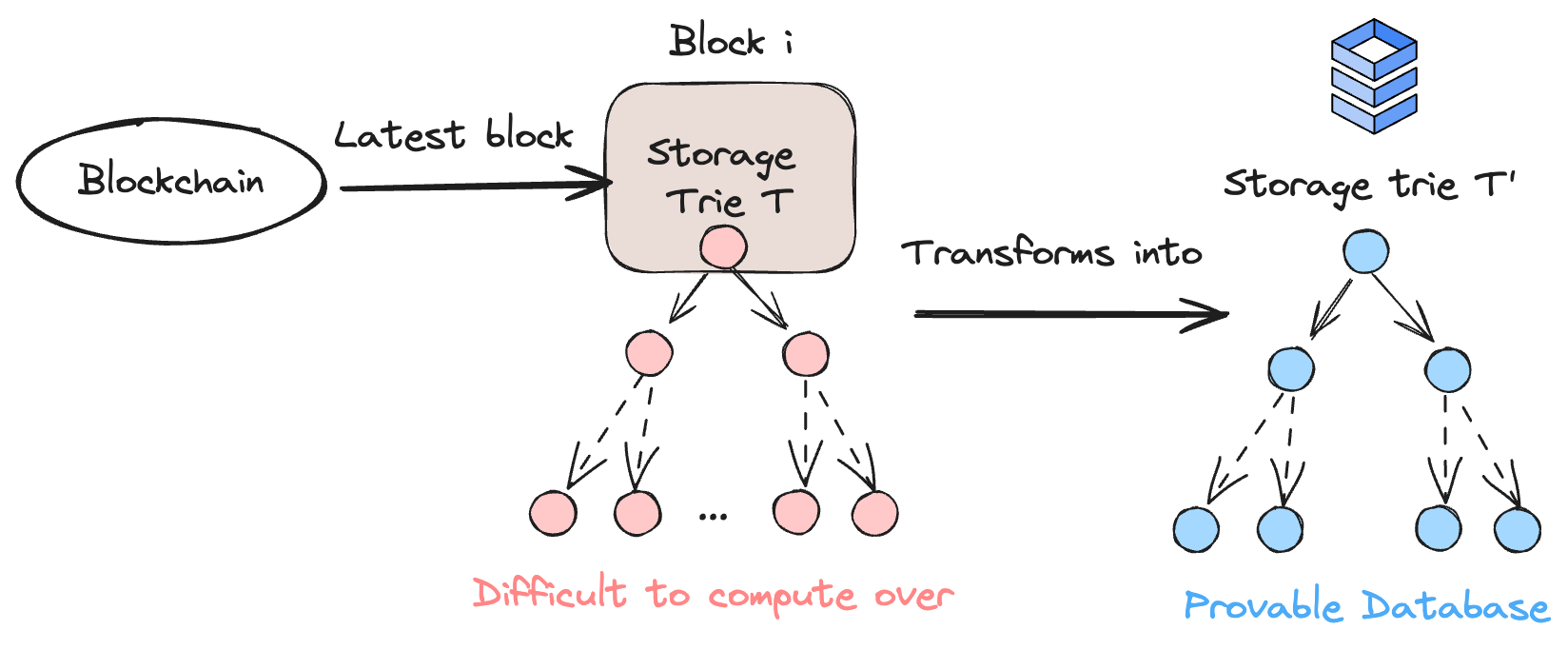
Lagrange's network functions as an advanced indexer that processes a contract's storage and transforms it into a verifiable database. The system essentially recreates the target blockchain's database (storage, state, and blocks) in a format that supports efficient and distributed queries.
Database Transformation Process
The ZK Coprocessor generates, for each block, a new equivalent version (shown in blue) of the original storage trie (shown in red), optimized for efficient queries. The system generates cryptographic proofs that this new database contains identical data to the original blockchain data structure.
Architecture Components
The Verifiable Database consists of three interconnected database layers, each optimized for specific types of queries and verification requirements:
1. Block Database
- Purpose: Stores and indexes block-level information
- Data Types: Block headers, transaction data, receipts, and metadata
- Optimization: Optimized for temporal queries and block range operations
- Verification: Provides cryptographic proofs of block inclusion and ordering
2. State Database
- Purpose: Manages account state and contract information
- Data Types: Account balances, nonces, contract code, and state roots
- Optimization: Optimized for account-level queries and state transitions
- Verification: Enables verification of state changes and account history
3. Storage Database
- Purpose: Handles contract storage data and slot-level information
- Data Types: Contract storage slots, mappings, and complex data structures
- Optimization: Optimized for storage-level queries and cross-contract analysis
- Verification: Provides proofs of storage inclusion and value correctness
Next Steps
Explore the detailed architecture of each database component:
- Onchain Storage: Onchain contract data storage
- Storage Database: Provable contract storage trie for optimization and querying
- State Database: Unified storage database of different contracts
- Block Database: Block-level data processing and storage
For implementation guidance, see the ZK Coprocessor Quickstart guide.