ZK Coprocessor Overview
The Lagrange ZK Coprocessor and Verifiable Database enable smart contracts to perform intensive computations offchain while maintaining cryptographic proof of correctness. This technology bridges the gap between blockchain's security guarantees and the computational requirements of modern applications.
Core Concept
The Lagrange ZK Coprocessor goal can be stated in simple terms:
Create a provable database containing a subset of the original blockchain data, which can be efficiently queried with cryptographic proof of correctness.
This is very similar to the notion of a "coprocessor," allowing smart contracts to run intensive computations offchain that can be efficiently verified onchain.
How It Works
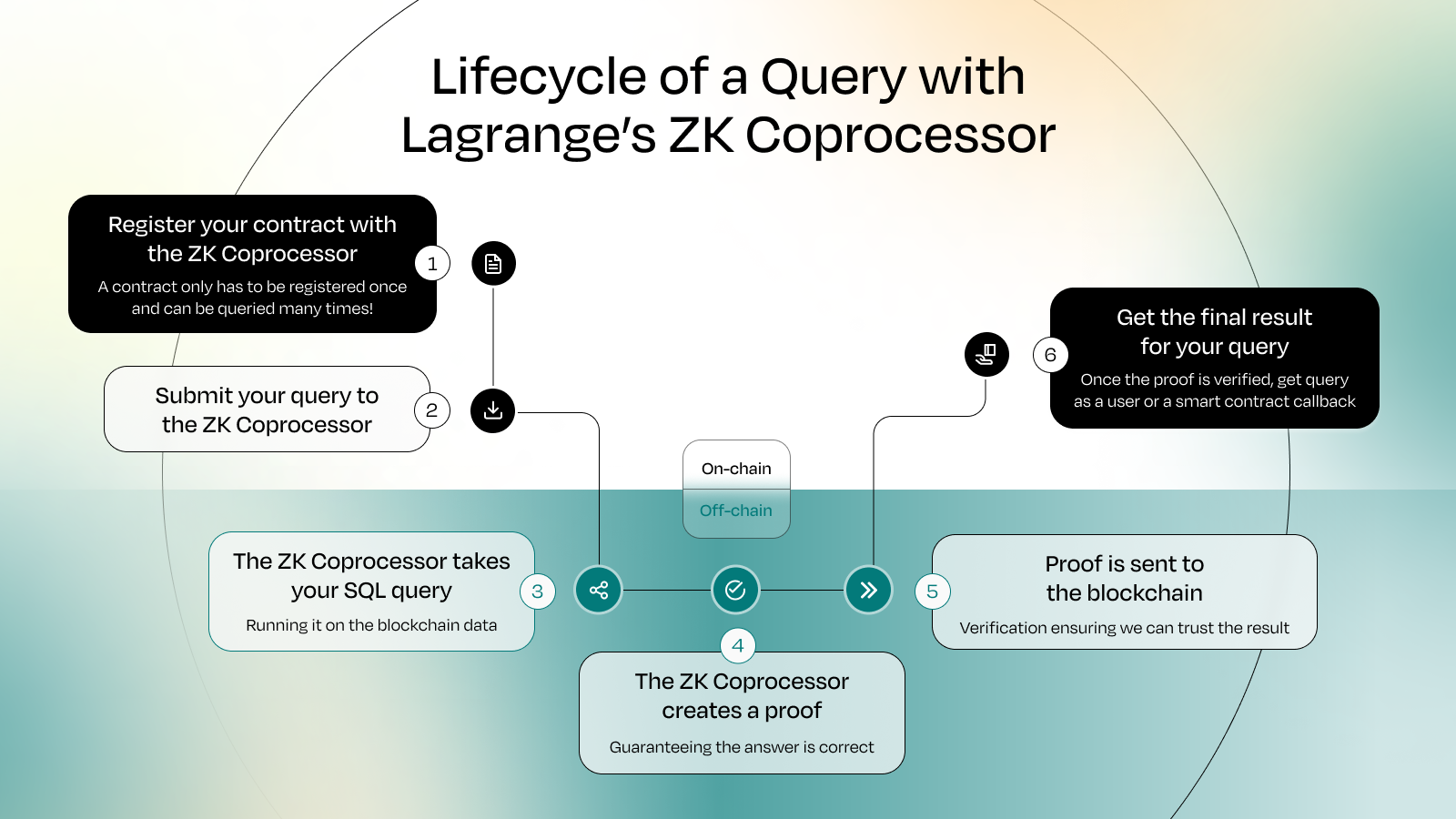
The ZK Coprocessor operates in two distinct phases:
Phase 1: Preprocessing (Data Indexing)
The system performs preprocessing or indexing of contract storage at each block, provably "inserting" the data into a Verifiable Database that supports efficient provable queries. This phase is the most computationally intensive due to most blockchain data structures not being "proof-friendly."
Key activities:
- Data Extraction: Extract relevant storage data from blockchain blocks
- Proof-Friendly Transformation: Convert blockchain data structures into formats optimized for zero-knowledge proofs
- Database Construction: Build verifiable database structures that support efficient queries
- Cryptographic Commitment: Generate cryptographic commitments to the transformed data
Phase 2: Query Execution (Provable Queries)
The system runs provable queries in parallel over the verifiable database when smart contracts request computations. This computation is performed in the spirit of MapReduce, as found in large-scale database processing tools.
Key activities:
- Query Processing: Execute SQL-like queries over the verifiable database
- Parallel Computation: Distribute query execution across multiple provers
- Proof Generation: Generate zero-knowledge proofs of query correctness
- Result Aggregation: Combine partial results into final outputs with aggregated proofs
Capabilities
Arbitrary Storage Queries
The ZK Coprocessor can generate proofs of correct computation over arbitrary storage slots for arbitrary block ranges.
Example Use Case: Consider an application that wishes to compute the average ETH/USDC price on Ethereum. The developer must:
- Specify Parameters: Define the memory slots and block range (~50,400 blocks) for the dataset
- Write Computations: Define the calculations to be executed across storage slots over different blocks in parallel
- Generate Proof: The system proves both storage inclusion and aggregated computation validity with respect to block headers
Cross-Chain Capabilities
The ZK Coprocessor can process smart contract storage on any EVM-based chain and answer queries for contracts on another chain, without requiring bridges.
Cross-Chain Example: A developer on Ethereum might want to:
- Compute the average price of a specific trading pair across different L2s
- Aggregate the results and receive them on the Ethereum contract
- All without using traditional bridge infrastructure
Technical Architecture
The system consists of two main components:
1. Verifiable Database Creation
- Blockchain Data Ingestion: Continuous monitoring and ingestion of blockchain data
- Storage Transformation: Converting blockchain storage tries into proof-friendly formats
- Database Optimization: Structuring data for efficient query processing
- Cryptographic Proofs: Generating proofs that the database accurately represents blockchain state
2. Distributed Query Processing (MapReduce)
- Query Parsing: Breaking down complex queries into parallelizable components
- Job Distribution: Distributing query components across the prover network
- Proof Generation: Creating zero-knowledge proofs for each query component
- Result Aggregation: Combining partial results and proofs into final outputs
Key Benefits
Scalability
- OffChain Computation: Move intensive calculations off the main blockchain
- Parallel Processing: Leverage distributed computing for complex queries
- Efficient Verification: Onchain verification is fast and cost-effective
Security
- Cryptographic Guarantees: Zero-knowledge proofs ensure computational correctness
- Trustless Operation: No need to trust external data providers or oracles
- Verifiable Results: All computations can be independently verified
Flexibility
- SQL-Like Queries: Familiar query language for developers
- Arbitrary Computations: Support for complex analytical operations
- Cross-Chain Support: Query data across multiple blockchain networks
Cost Efficiency
- Reduced Gas Costs: Expensive computations performed offchain
- Optimized Verification: Minimal onchain verification overhead
- Scalable Pricing: Costs scale with computation complexity, not blockchain fees
Use Cases
DeFi Analytics
- Price Aggregation: Compute time-weighted average prices across multiple DEXs
- Liquidity Analysis: Analyze liquidity depth and distribution
- Risk Assessment: Calculate portfolio risk metrics across protocols
- Yield Optimization: Identify optimal yield farming strategies
Cross-Chain Applications
- Multi-Chain Governance: Aggregate voting power across different chains
- Cross-Chain Portfolio Management: Track assets across multiple networks
- Interchain Analytics: Analyze activity patterns across blockchain ecosystems
Gaming and NFTs
- Leaderboards: Maintain verifiable game leaderboards
- Achievement Systems: Track and verify player achievements
- NFT Analytics: Analyze NFT trading patterns and valuations
- Reward Distribution: Calculate and distribute rewards based on complex criteria
Enterprise Applications
- Compliance Reporting: Generate verifiable compliance reports
- Audit Trails: Create tamper-proof audit logs
- Performance Analytics: Analyze business metrics with cryptographic guarantees
Next Steps
The following sections provide detailed technical information about the ZK Coprocessor:
Architecture Deep Dive
- Verifiable Database Architecture: Detailed technical architecture
- Block Database: Block-level data processing
- State Database: State management and verification
- Storage Database: Storage optimization and querying
Getting Started
- Quickstart Guide: Build your first ZK Coprocessor application
- Upcoming Features: Roadmap and planned enhancements
Advanced Topics
- zkMapReduce: Understanding the distributed computation framework
- Efficiency Improvements: Performance optimization techniques
The ZK Coprocessor represents a fundamental advancement in blockchain computation, enabling applications to leverage the full power of modern computing while maintaining the security and decentralization properties that make blockchain technology valuable.