ZK Prover Network Overview
The Challenge with Traditional Prover Networks
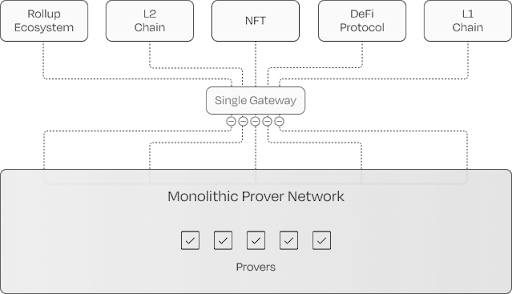
Traditional, monolithic ZK prover networks rely on single gateway models, which inherently limit scalability with the gateway as the bottleneck. They also act as a single point of failure for the system:
What is the Lagrange ZK Prover Network?
The Lagrange ZK Prover Network (LPN) is a modular, infinitely scalable foundational proving layer designed to unlock universal proof generation for a variety of use cases, such as rollups, ZK Coprocessor, DApps, and interoperability at internet scale.
Key Features
- EigenLayer Integration: Deployed on EigenLayer and supported by over 85 top institution-grade operators including Coinbase, OKX, P2P, Nethermind, and others
- Modular Architecture: Each operator runs multiple provers to deliver ZK proofs requested by users
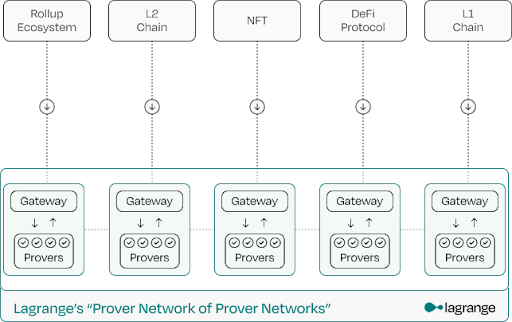
- Subnetwork Support: Multiple independent subnetworks with dedicated bandwidth that collectively form a "prover network of prover networks"
- Customizable Standards: Any blockchain, rollup, or application can connect through customizable standards and scale without bottlenecks or I/O constraints
Architecture Benefits
The ZK Prover Network supports multiple independent subnetworks with dedicated bandwidth that collectively form a "prover network of prover networks". This approach allows any blockchain, rollup, or application to connect through customizable standards and scale without bottlenecks or I/O constraints.
This model guarantees:
- High liveness and availability
- Simple interface for integration
- Support for complex proof generation required for large ecosystems
Problems Solved
Lagrange ZK Prover Network addresses key challenges experienced by rollups and applications:
Scalability Issues
- Eliminates single-threaded bottlenecks
- Enables seamless handling of thousands of proof requests simultaneously
- Maintains performance even during peak demand
Availability Concerns
- Removes single points of failure through decentralized architecture
- Distributes proof generation across a network of operators
- Ensures consistent service availability
High Proving Costs
- Reduces operational expenses through competitive marketplace dynamics
- Optimizes resource allocation across the network
Proof Computation Latencies
- Minimizes delays through efficient job distribution
- Leverages parallel processing capabilities
- Provides predictable performance metrics
Censorship Resistance & Decentralization
Lagrange's ZK Prover Network eliminates censorship and liveness risks by distributing proof generation across a decentralized network of operators. This design ensures seamless handling of thousands of proof requests simultaneously, even during peak demand, without reliance on a single point of failure.
Together, these capabilities empower builders to scale with confidence, knowing that proof generation will never become a bottleneck.
What Makes Lagrange's ZK Prover Network Unique?
While many initiatives promise democratized access to ZK proofs, Lagrange sets itself apart through a relentless focus on specialized performance and enterprise-grade reliability. The following pillars illustrate why our network stands in a league of its own:
Specialized Hardware Optimization
- Custom-built proving infrastructure optimized for specific ZK circuits
- Hardware-aware job scheduling and resource allocation
- Performance benchmarks that exceed industry standards
Enterprise-Grade Reliability
- 99.9% uptime guarantees backed by institutional operators
- Automatic failover and redundancy systems
- Comprehensive monitoring and alerting infrastructure
Seamless Integration Experience
- Simple APIs that abstract away cryptographic complexity
- Comprehensive SDK support for major development frameworks
- Extensive documentation and developer resources
Economic Sustainability
- Transparent pricing models with competitive market dynamics
- Predictable cost structures for enterprise planning
- Incentive alignment between provers and users
These advantages translate into predictable latency, reduced operating costs, and stronger security guarantees - qualities that are essential for mainstream adoption of zero-knowledge technology.
Next Steps
- Architecture Deep Dive: Explore the technical architecture and components
- Become an Operator: Learn how to join the network as a prover operator
- ZK Coprocessor: Discover verifiable database capabilities
- Integration Guide: Get started with your first implementation